What Is the Texas Two-Step in Practical Terms?
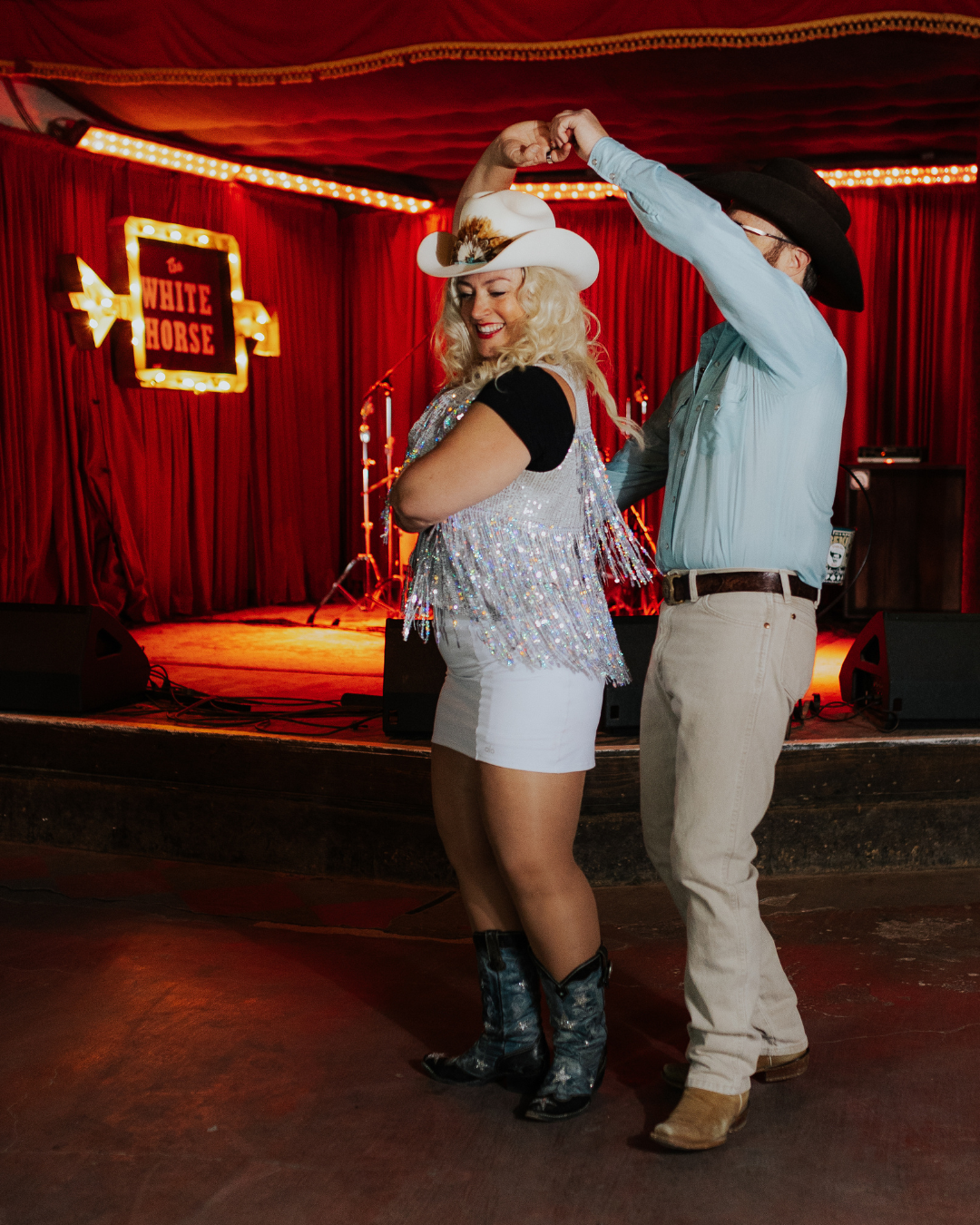
The Texas Two-Step is best understood not as a fixed choreography but as a traveling social partner dance organized around a steady rhythm—commonly described as quick-quick, slow-slow—and designed to move continuously around a shared floor (TSHA, n.d.). That emphasis on navigation and flow distinguishes it from stationary or performance-oriented forms. It is still widely taught and practiced in Texas dance halls and community venues, making it a living tradition rather than a revived one (Texas Monthly, 2018).
Where Did It Come From?
No single origin point defines the Texas Two-Step. Instead, it developed through layered cultural influences typical of Texas history. Nineteenth-century German and Czech immigrants who settled in Central Texas brought social dances such as the polka, which emphasized forward motion and rhythmic clarity (TSHA, n.d.). These traditions became embedded in community dance halls—institutions that functioned as civic and social centers across rural Texas (Boyd, 2012).
Over time, these European-derived forms interacted with broader American partner dances, including the foxtrot, which introduced a smoother traveling structure adaptable to popular music (Malone, 2002). In Texas settings, that structure was simplified and made more practical, producing a regional variant suited to crowded, informal environments rather than formal ballrooms (Texas Monthly, 2018).
Why Bob Wills Is Still the King
The development of the Texas Two-Step cannot be separated from the rise of western swing. Bob Wills (chatgpt://generic-entity?number=0) and his Texas Playboys helped establish a musical style explicitly oriented toward dancers, blending fiddle traditions, jazz rhythms, and country instrumentation (Townsend, 1976).
Venues such as the Crystal Springs Dance Pavilion in Fort Worth became major centers for this music, reinforcing the connection between Texas music and social dancing (TSHA, n.d.). Western swing was not simply performed—it was danced—and that dynamic helped stabilize the Two-Step as a recognizable form.
Ray Price and the Dancer’s Beat
In the late 1950s, Ray Price (chatgpt://generic-entity?number=1) introduced and popularized a 4/4 shuffle rhythm—often called the “Ray Price Beat”—that reshaped country music for dancers (Country Music Hall of Fame, n.d.). This rhythmic shift made songs more compatible with continuous partner movement and reinforced the centrality of dance in Texas country traditions.
The distinction matters. While Nashville increasingly prioritized radio-friendly arrangements, Texas music retained a strong orientation toward danceable rhythm and live performance environments (Malone, 2002). The Texas Two-Step became one of the clearest expressions of that difference.
A Living Line: Ray Benson and Continuity
That tradition continues through artists such as Ray Benson (chatgpt://generic-entity?number=2) and Asleep at the Wheel (chatgpt://generic-entity?number=3), whose decades-long work has preserved and reintroduced western swing to new audiences. Benson’s stage production A Ride with Bob further underscores the continuity between early western swing and contemporary Texas dance culture (Benson, 2015).
This continuity is important for policy audiences: it demonstrates that the Texas Two-Step is not a historical artifact but part of an ongoing cultural ecosystem.
Postwar Dance Halls and Standardization
Following World War II, amplified bands, larger crowds, and a network of community dance halls contributed to the standardization of social partner dancing in Texas (Boyd, 2012). Some venues were purpose-built halls, while others were smaller local establishments where space constraints required tighter movement.
This produced a spectrum of styles. In large halls such as Anhalt Hall, dancers could travel more expansively. In smaller venues—such as neighborhood honky-tonk settings like Ginny’s Little Longhorn in Austin—the dance often compresses, incorporating sharper turns and more compact patterns. In these environments, the Two-Step can take on qualities resembling a regional swing or jitterbug adaptation.
Rather than representing a deviation, this variation reflects the defining feature of the dance: adaptability to space and music (Texas Monthly, 2018).
Who Participates—and Why That Matters
While the Texas Two-Step is often visually associated with country western settings, its historical development reflects multiple cultural inputs and shared social use. Dance halls themselves have long functioned as community spaces where different populations intersect through music and movement (Boyd, 2012).
Contemporary practice reflects that breadth. Instructors, students, and social dancers across Texas represent a wide range of backgrounds. What unifies participation is not identity but accessibility: the dance is teachable, repeatable, and usable in real-world settings.
For legislative consideration, that distinction is significant. The Texas Two-Step is not confined to a niche or symbolic demographic—it is a broadly practiced social form embedded in Texas life.
Why Recognition Is Appropriate
Texas currently recognizes the square dance as its official folk dance, but it does not designate an official state dance (Texas State Library and Archives Commission, n.d.). The Texas Two-Step meets several criteria commonly used in cultural designation:
It is historically grounded yet still evolving.
It is widely practiced across the state.
It reflects Texas’s multicultural development.
It remains functionally embedded in community life.
Recognition would not create a tradition. It would acknowledge one that already exists.
Conclusion: A Working Tradition
The Texas Two-Step endures because it solves a practical problem: it gives people a way to move together, in real time, in shared spaces, with minimal barriers to entry. It connects music, history, and community in a form that is both structured and flexible.
From Bob Wills to Ray Price to Ray Benson, from nineteenth-century halls to present-day instruction, the dance represents continuity without rigidity. It is not preserved by institutions alone but by repeated use—lesson by lesson, floor by floor.
For that reason, it stands as a credible candidate for recognition as an official symbol of Texas cultural life.
⸻
References
Benson, R. (2015). A Ride with Bob [Stage production]. Austin, TX.
Boyd, D. (2012). Dance Halls of Texas. Texas A&M University Press.
Author bio: David Boyd is a Texas historian and photographer whose work documents the history and cultural role of dance halls across the state.
Country Music Hall of Fame. (n.d.). Ray Price biography.
Author bio: The Country Music Hall of Fame is a leading institutional authority on the history of American country music, maintaining archival and scholarly resources.
Malone, B. C. (2002). Country music, U.S.A. University of Texas Press.
Author bio: Bill C. Malone is a pioneering historian of country music and a former president of the American Historical Association.
Texas Monthly. (2018). The Texas Two-Step and its cultural roots.
Author bio: Texas Monthly is a major regional publication known for long-form journalism on Texas culture, history, and identity.
Texas State Historical Association (TSHA). (n.d.). Entries on Anhalt Hall, Crystal Springs Dance Pavilion, Broken Spoke.
Author bio: TSHA is a scholarly organization dedicated to documenting Texas history through its Handbook of Texas, a widely cited academic resource.
Texas State Library and Archives Commission. (n.d.). State symbols of Texas.
Author bio: The Texas State Library and Archives Commission maintains official records and reference materials on Texas government and state symbols.
Townsend, C. R. (1976). San Antonio Rose: The life and music of Bob Wills. University of Illinois Press.
Author bio: Charles R. Townsend is a music historian specializing in western swing and American popular music traditions.